
I arrived in Budapest at 10:30am this morning on a flight from Frankfurt (Lufthansa LH1336, an Airbus A320neo, registration D-AIJD). That may sound like a short trip, but it was the third leg of a 23-hour journey from Maseru (Lesotho) where I had been working with a school board for the previous 18 days.
I took the public bus from Budapest’s Ferenc Liszt Airport to the city centre and walked the remaining kilometre or so to my hotel, the brilliantly located Intercontinental Hotel where I had managed to get a room for two nights using points. I had known of this hotel since my first visit to Budapest in 1987 when Hungary was still Communist. At that time, it was the state-owned Forum Hotel, just six years old and situated right beside the Danube River. It had stood out like a shiny futuristic vision among decades-old stone structures as I took photos of the city’s skyline from the Buda hills on the opposite side of the river, so it was quite an experience to find myself staying there 37 years later.
My afternoon exploring of Budapest began from the window of my hotel room. The day was sunny with blue skies, and the midday sunlight illuminated the Danube River and the western hills magnificently.
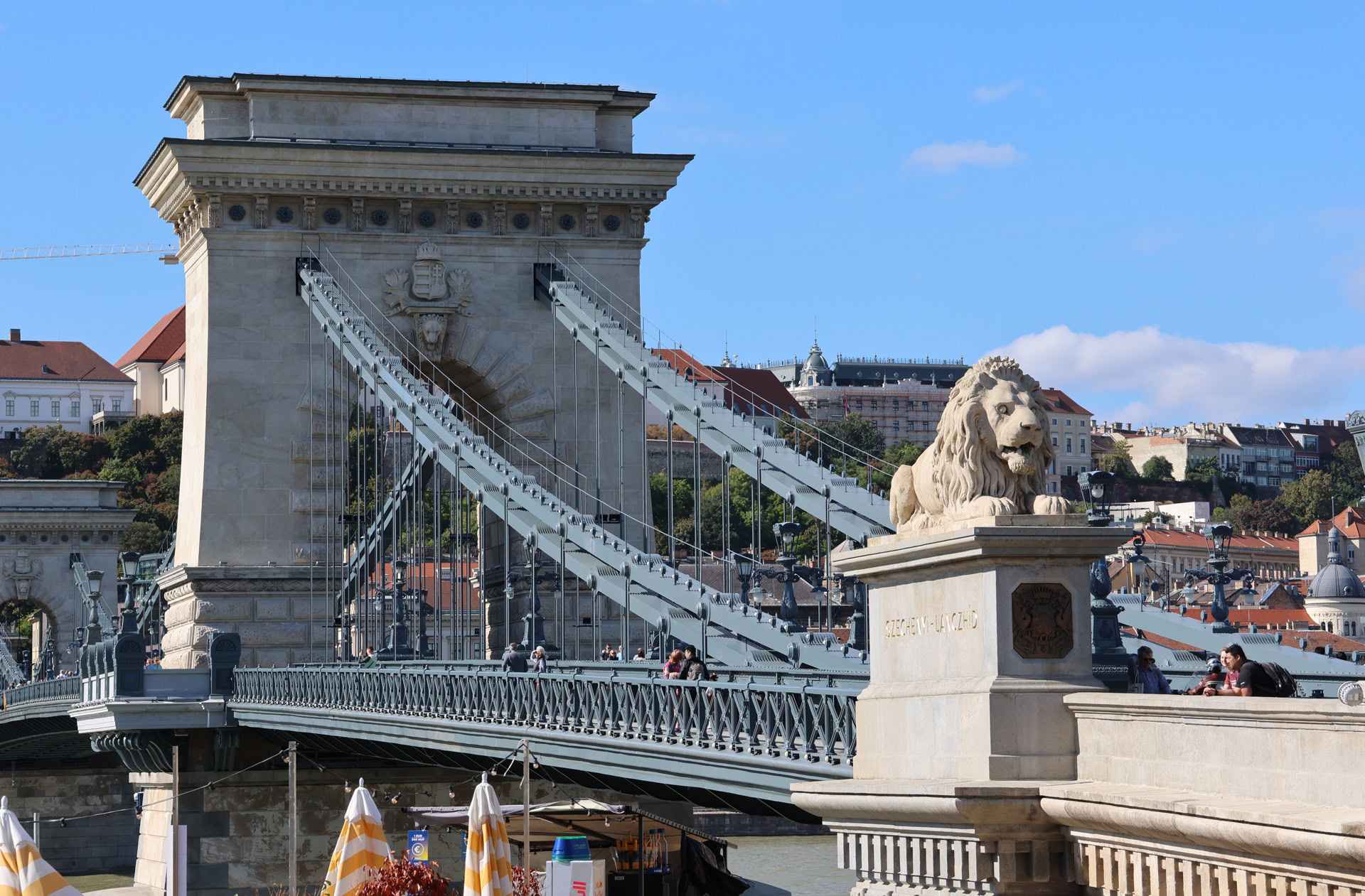
The city seemed to be calling out to me to go for an exploratory walk, and so I did in the form of a 12.1-kilometre anticlockwise walk around central Budapest. My route took me east from the hotel along Jósef Attila Street, through Erzsébet Park, then north along Bajcsy Zsilinszky Street, past Budapest-Nyugati (Budapest-West) Railway Station, through some backstreets to the north of Szent István Circuit, across the Margit Hid Bridge that crosses the Danube River, up into Castle Hill, and back across the Danube River on the beautiful Széchenyi Lánchid Bridge.
One of my aims during the walk was to find places I had seen and photographed in 1987 when visiting with my family. This was not an easy task as I hadn’t made precise records of my earlier visit, and more significantly, several of the places I had visited were no longer accessible.
One example of that was a café balcony we had visited in 1987 which overlooked the large intersection near Nyugati (Western) Station where Bajcsy-Zsilinsky Street crosses Teréz Circuit and Szént István Circuit in an overhead roadway to join Váci Circuit. I was hoping to get onto the same balcony to re-photograph the intersection, but unfortunately it was now completely sealed off, and I had to make so with a ground-level photo from a similar angle.
Similarly, a balcony overlooking Budapest Castle where I had been photographed with my six-year-old daughter and four-year-old son in 1987 was now cordoned off as part of a restaurant, so I had to get a similar angled photo from a different elevation. I had better luck re-visiting some other streetside locations in the Castle district where accessibility was still possible despite some changes in the roadways and fenced-off zones.
A highlight of my walk was visiting the ruined church of Saint Mary Magdalene, a location I had not previously explored. Although there was not much left of the main body of the church, it was possible to go to the top of the spire where wonderfully clear views of Budapest’s skyline were available without the crowds that clogged the main sections of Castle Hill. The views across the nearby red roofs and the Danube River to Hungary’s amazing Gothic Parliament Building were especially impressive.
The day’s walk was long but it provided me with an excellent re-orientation of Budapest. With a view across the Danube River from my hotel room, I could not have wished for better views as the evening revealed the floodlit buildings of the Buda Hills and the lights adorning the bridges across the Danube and the boats beneath. My first day in Budapest was everything I could have wished for, and more.