Is scepticism really all that sinister?
Sunday, 17 January 2010
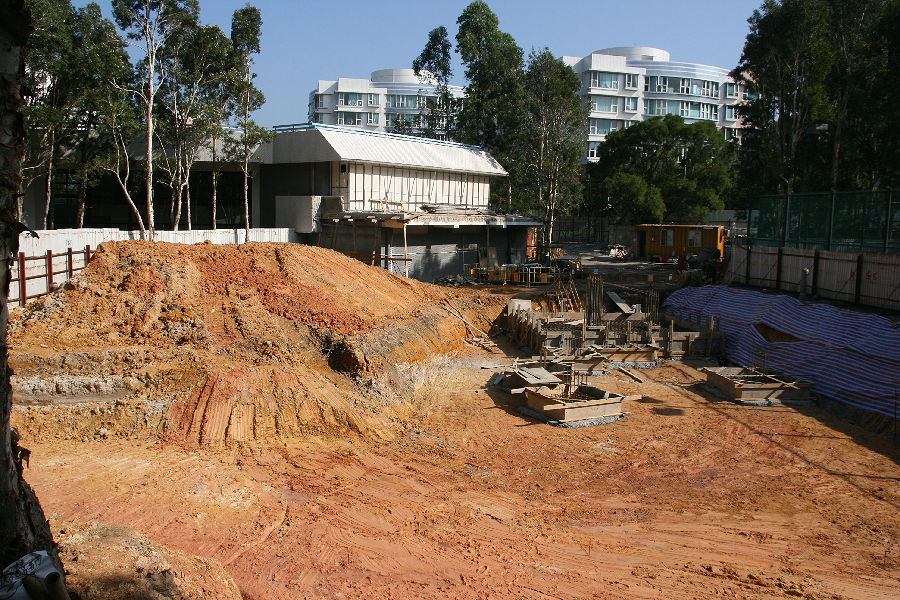
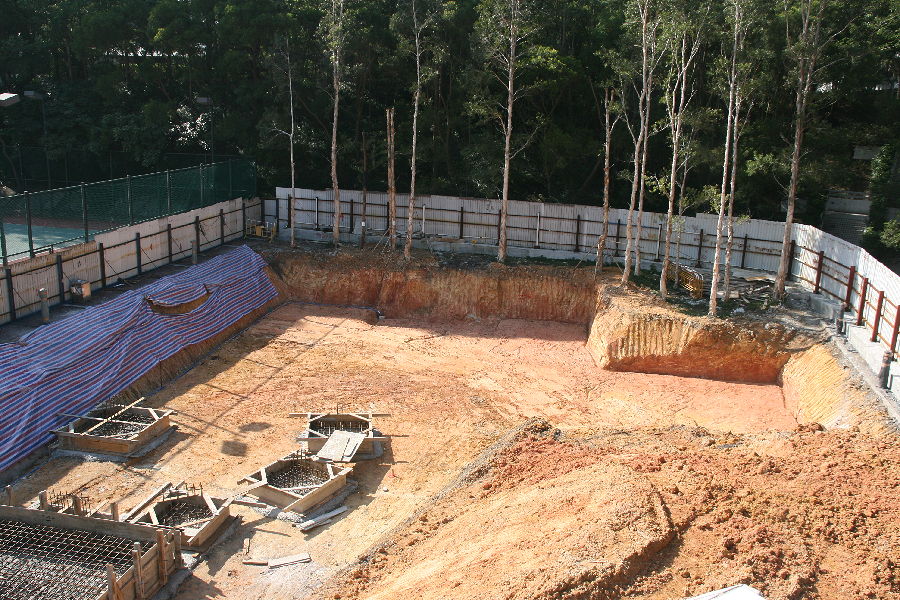
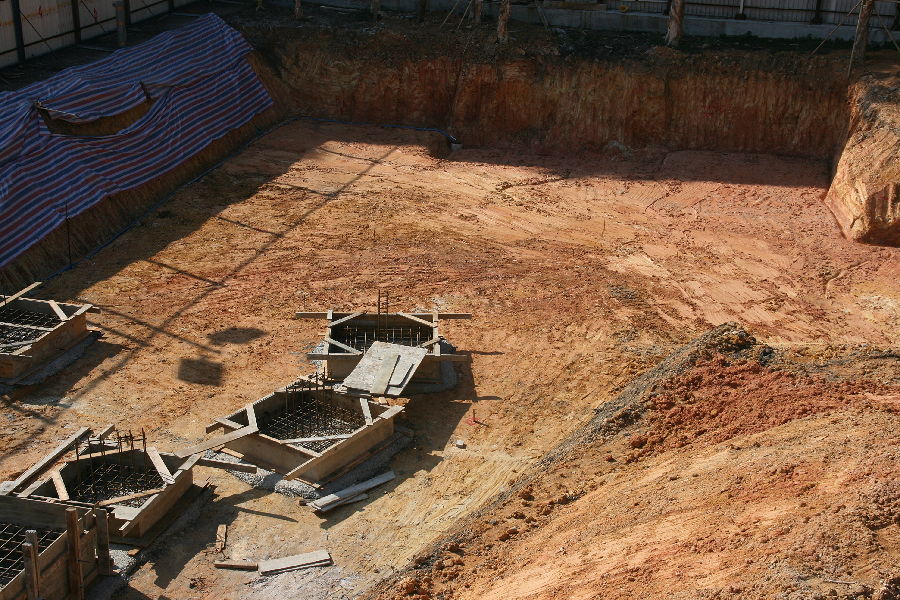
I was having breakfast with a few students in an unusually quiet canteen one morning this week when the conversation focussed on the construction of our new auditorium (see photos on this page – and please understand it is not easy to get any photogenic angles of a huge orange hole in the ground). Our conversation centred on the apparently slow progress of construction and its likely completion date.
I told the students that according to the latest information given to me, the construction should be finished in late September or early October, but I added I was more than a little sceptical of what I felt might be quite an optimistic forecast. The reaction of one of the students surprised me: “Oh, please don’t become a sceptic!”.

I had always viewed scepticism as something healthy (within reasonable bounds of course), and I had always seen it as being quite different from cynicism, which is what I sensed the student was discussing. But no – the student was adamant that to be a sceptic was a ‘very bad’ thing because it implies you are a climate change denier!
In my classes, Geography as well as Theory of Knowledge, I have always suggested to students that they ought to test new knowledge and new claims through the filter of healthy, enquiring scepticism. Indeed, I had seen scepticism as the traditional basis of legitimate scientific enquiry. It struck me that we might be entering a strange era indeed if the word sceptic (as used in the term “climate sceptic”) was coming to be used as an insult.
A healthy sceptic does not merely take things on trust, but scrutinises the reliability of evidence, and then appraises the hypotheses and arguments arising from that evidence before coming to a conclusion on a particular matter, or making a judgement. And even then, an honourable sceptic would acknowledge that this judgement could only be provisional because there is always the possibility that new evidence or a better explanation might emerge.
The basis of progress, and also freedom as many would argue, is the flourishing of a range of diverse viewpoints and the contention of competing ideas. The chairman of the board at one of the schools where I was formerly Principal often commented that he was always happy to have seemingly crazy ideas thrown around, because even if 99 ideas out of every 100 turned out to be impractical it meant that the one good idea which might otherwise have been lost could be brought to fruition. Of course, he was not the one who had to spend the time filtering the 100 lousy ideas! The price of openness is to allow both the sagacious and the ratbags to have their say – but hopefully not always to have their way!
Scientific ideas, historical interpretations, and indeed educational philosophies, are never settled. There will always be challenges as new data and new arguments come to light – which often lead to new conclusions, such as the revised completion date of our auditorium.

Perhaps equating ‘sceptic’ with ‘denier’ is just a crude rhetorical device designed to silence opposition. Whether this is so or not, my student’s viewpoint suggests that there may be one group of people – the global warming advocates – who could have succeeded in translating their interpretation of the evidence into a dogma that is beyond challenge, at least among the general population. As an article in ‘The Australian’ newspaper a few weeks ago proposed, this is not a form of scientific activity but a political act.
What I am suggesting here is emphatically not an anti global warming polemic. My (hopefully well researched and balanced) views on anthropogenic climate change are well documented and  publicly available in my geographical writings. The concern I want to express here is the dilution of a healthy spirit of enquiry as a result of the media’s over-simplistic treatment of issues such global warming (which I am simply using as an example), and the apparent politicisation of the issue.
Politics and substantial issues are of course inevitably intertwined. It is right that governments should take action on issues that adversely affect otherwise disempowered people, and evidence suggests strongly that global warming probably fits into that category. However, the process of translating the provisional explanations of true scientific enquiry into clear government policy is problematic at best. Clear decisive action requires certainty, and politicians prefer that the scientific arguments supporting their actions should not be open to question.
Therein lies the dilemma.
The science and the geography that underpin climate change are extraordinarily complex. The mathematical models that try to predict and analyse it are becoming increasingly complicated, and yet as their complexity grows, so does our understanding of their sheer inadequacy in the face of new insights. Indeed, I read an article recently that equated the actual over-simplicity of the apparently complex climate change models to the same computer models that led last year to the Global Financial Crisis. The interaction between greenhouse gases (of which carbon dioxide is just one of many) and global temperatures is so complicated that it can only be understood via a combination of complex physical measurements and mathematical analysis. It is not a subject that you can just ‘debate’.
In that context, many people are happy to support the case for action against climate change simply on trust. They have seen Al Gore’s film, they know he received the Nobel Peace Prize for it, the scientists have spoken and they are happy to accept what the authorities (i.e. those empowered with the knowledge) have said.
And yet, my Theory of Knowledge students all know that one of the weakest substitutes for reasoning or argument is an ‘appeal to authority’. Although I don’t disagree with many of the  statements made by climate change advocates, I do despair at the willingness of many to accept so much on authority and not question some of the wilder claims more critically - indeed, I think it is actually dangerous.
Furthermore, I have heard and read many people argue that in the end it doesn’t really matter whether or not it turns out that global warming is not caused by humans. They assert that cleaning up carbon emissions and being more environmentally conscious are positive outcomes irrespective of the science, and so we should ‘just do it’. Whether these well-intentioned people are right or wrong (which is not my point here), the reasoning behind such claims seems singularly tangential to me.
Perhaps education has an important role to play here. I heard it suggested (on many occasions and in many diverse places) that modern education teaches students that the political is more important than the intellectual. Political action seems to trump rigorous intellectual investigation.
If that is so, and without wishing to suggest that the political and the intellectual are completely dichotomous, then there is a significant problem within education that only education can overcome.
Education should be a process of enlightenment, not indoctrination.