Potential and merit as measures of excellence
Sunday, 10 January 2010
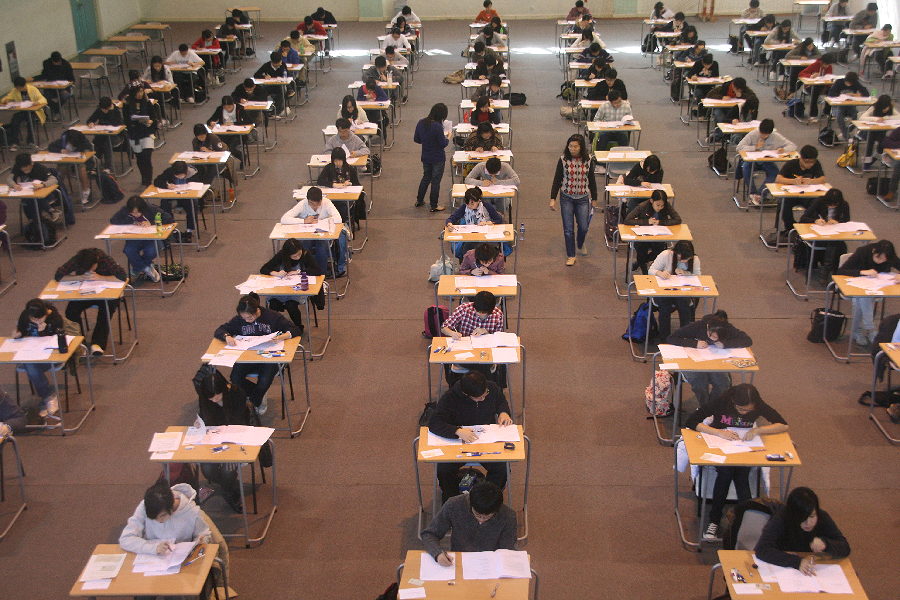
This weekend about 500 Hong Kong students who have applied to enter Li Po Chun United World College and overseas UWCs in September this year completed their aptitude testing in our Sports Hall. Despite the large size of our indoor sports facilities, we needed four sessions over two days (Saturday and Sunday) to complete the process. The photo below shows part of the scene during one of those sessions.
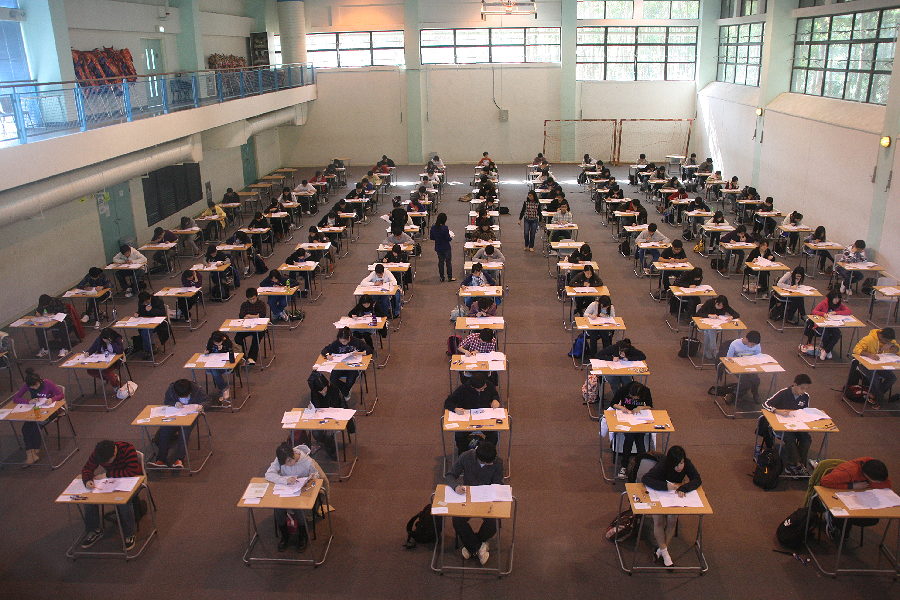
This weekend’s aptitude testing comprised four components: reading comprehension, mathematical and scientific reasoning, written expression and abstract reasoning. Speaking with several of the students after supervising the first session on Saturday morning, I got the clear impression that the students had found the test to be very difficult. This was not a surprise for me – after all, the test we used was called the ‘Higher Ability Selection Test’ – and the students who trialled the test last year provided me with exactly the same feedback. Although the students might have felt more comfortable with an easier test, we do need to separate students by ability fairly ruthlessly to ensure that the students we accept have the ability to thrive in the sometimes arduous IB program within the demanding context of a boarding UWC environment that places an often time-consuming focus on community service and other aspects of the CAS program. Moreover, as the test is being used as a ranking exercise, the applicants have nothing to fear from a rigorous set of tests.
When the abolition of the HKCEE was announced, there was some debate within the Hong Kong UWC Selection Committee as to whether we should introduce our own formal testing or not. Many overseas UWC Selection Committees use academic testing, but there are many others that do not. Overall, there is a tendency for larger Selection Committees to use academic testing and for committees that receive smaller numbers of applications not to do so. With about 500 applications each year (the vast majority of which are for Li Po Chun UWC in Hong Kong), the  Hong Kong Selection Committee manages one of the world’s largest UWC selection processes – and one of the most successful given the high calibre of its graduates over many years.

Almost since the beginnings of the United World Colleges, the basic criterion for selection has been the ‘merit’ of the applicant. The concept of merit has been interpreted differently in various parts of the world according to cultural traditions and priorities, and this has provided the Colleges with a wonderfully diverse mix of students who differ not only in their nationality and background but in their aptitudes, outlooks, abilities and priorities. In recent years, however, there has been a debate within the UWC Movement over whether ‘merit’ should be replaced by ‘potential’ as the basic criterion for selection. Part of that debate has been the difficulty of defining and thus measuring ‘potential’, and I’ll return to that point a little later in this blog.
Whether ‘merit’ or ‘potential’ wins this battle, the simple aim is to select students who are capable of all-round excellence. Indeed, it was this commitment to educational excellence that drove the Hong Kong Selection Committee to adopt its own testing from this year.
Perhaps surprisingly, I occasionally hesitate before I use the word ‘excellence’ in certain circles because of the reaction the word sometimes generates. Like ‘democracy’, the word ‘excellence’ has been purloined by some folk who use the word as the very antithesis of what I believe is its true meaning. Furthermore, as the word becomes more and more widely used – and distorted –in some educational circles, there is a real danger that it becomes seriously diluted and devalued. Excellence is frequently referred to by politicians, quoted by scholars and bureaucrats, and sought tenaciously by most teachers – certainly the ones at LPCUWC. I seriously wonder whether all these people could possibly be referring to the same concept of excellence when they use the word!
The notion of excellence had very early beginnings in human history. In Homer’s works, it was expressed in the word ‘arete’ which is derived from ‘ares’, the Greek deification of the war-like spirit (as distinct from the god of war). Homer used the word to describe qualities of masculinity, valour and nobility. Socrates extended its meaning to include moral and intellectual considerations, and his pupil, Plato, later extended the concept to include women.
By the time of Aristotle, ‘arete’, or excellence, had become identified as a conjunction of virtue and knowledge. To be excellent in Aristotelian terms was to have both the capacity for excellence and the desire to strive towards its attainment.
The argument among scholars and teachers since the time of Plato and Aristotle has been essentially over the question of whether excellence is the achieving of the maximum possible capacity of an individual, or whether it an individual achieving goals set externally by others. We could simplify the difference and refer to the former as ‘potential’ and the latter as ‘merit’ to mirror the terminology of the UWC International selection criteria.

I want to suggest that excellence is tied to the concept of quality, and a really high quality performance, as we judge it, is often described as ‘excellent’. Although I have reservations about aspects of Robert Persig's 1974 book ‘Zen and the Art of Motorcycle Maintenance’, it offers an interesting perspective on this notion of quality:
-
“You know what it is, yet do not know what it is. But this is self contradictory .... if you cannot say what Quality is, how can you know what it is, or how can you say that it even exists? If no-one knows what it is then for all practical purposes it does not exist at all. But for all practical purposes it really does exist. What else are grades based on? Why else would people pay fortunes for some things and throw others in the trash pile? Obviously some things are better than others ... but where is the 'betterness'? So round and round you go, spinning mental wheels and nowhere finding any place to get traction. What is Quality?”
Persig is right in that we do rank things and in so doing we impose our own value systems on them. Some of us are much more conscious of our value systems than others. For example, I explicitly encourage my students to think often and deeply about such values as honesty, respect, courage and compassion, as these represent excellence in the area of morality. As I say to the new students when they first arrive at LPCUWC, “every decision you make, large and small, will have an impact on the person you are and the person you will become”.
One challenge of implementing authentic excellence in the field of education is that educators serve so many masters with different concepts and priorities. There is thus a multitude of criteria and these vary among politicians, parents, school boards, the community, students, teachers, donors, and so on. As a result, excellence ultimately comes to be about quality as a given judge sees it. The more powerful the judge, the greater the chance that his or her definition of quality will be accepted. And that is the value of being an independent school such as LPCUWC – ultimately we are in control of our own vision of excellence that can be developed, enhanced and refined specifically to suit the particular needs of our own very distinctive group of students.
Those students who are finally accepted can be quite confident that they possess many qualities of all-round excellence, and that these qualities have been recognised and acknowledged. The sad corollary is that I know many other excellent students will have to be turned away because our place numbers are so limited.